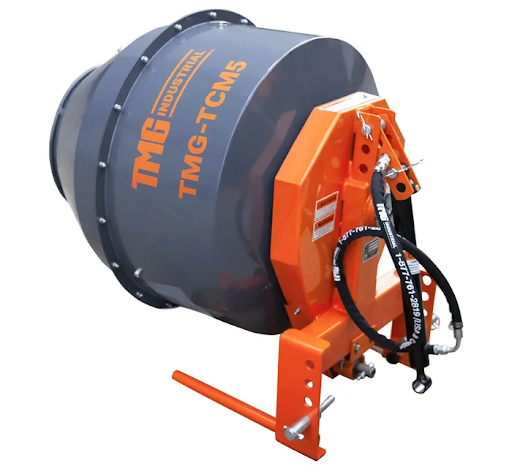
Two machines of identical drum volume can turn out noticeably different concrete, and the cause is almost always inside the drum rather than in the drive. Mixing happens because material is lifted up one side, dropped through the air, and folded back in, and the blades that do the lifting determine how completely that happens.
A concrete mixer whose drum turns without effective blades is really just a tumbler. The aggregate rolls, the cement paste coats the outside of the mass, and the center of the charge never gets wetted properly. The result looks mixed and is not, which shows up later as variable strength rather than as anything visible on the day.
Blade Angle Does the Mixing, Not Drum Speed
Blade pitch in a concrete mixer controls how material moves along the drum axis while it is being lifted. Correctly angled blades produce a continuous figure-eight circulation: material travels toward the back, falls, travels forward, and falls again. Blades set too flat simply carry material around the circumference without that axial movement.
Speed has a narrow useful band. Too slow and the charge slides instead of being lifted; too fast and centrifugal force holds it against the drum wall so nothing falls at all. Manufacturers set drum speed inside that band, which is why a mixer driven at the wrong input speed produces poor results despite everything else being correct.
Charge volume matters for the same reason. A drum filled beyond roughly its rated batch has no air space for material to fall through, and overfilling is the most common operator error with any 3-point hitch cement mixer. Running a smaller batch mixes better and faster than running an oversized one.
Charge Order Changes the Result
Experienced operators add a portion of the water first, then the aggregate, then cement, then the remaining water. Starting with water prevents cement from packing into dry corners of the drum, and adding aggregate before cement lets the stones scour the drum wall rather than letting paste build up on it.
Adding all the water last is the usual shortcut and the usual cause of cement balls. Dry cement wetted suddenly forms lumps with dry centers, and once formed those lumps survive a full mixing cycle. They then end up in the pour as weak points.
Mix time has an optimum rather than a minimum. Under-mixing leaves the problems above; over-mixing in a small drum breaks down aggregate edges and drives entrained air out, both of which reduce the finished strength slightly. A few minutes after the last water goes in is usually sufficient.
Hitch Mounting Shifts the Weight Problem
A loaded drum of this size weighs several hundred pounds, and all of it hangs behind the rear axle. The arithmetic is the same as with any rear implement: the tractor’s front end gets lighter, steering gets vague, and on a slope the situation deteriorates faster than most operators expect.
Front ballast is the answer and it needs to be in place before the first batch rather than after the first unsettling moment. A loader or weight box is sufficient; the important part is that it stays attached while the mixer is loaded.
Discharge geometry is the reason to choose hitch mounting at all. A drum that rotates to pour at wheelbarrow height, positioned by the tractor rather than carried to the work, removes most of the shoveling from a small pour. For a fence line or a run of footings spread across a property, that mobility is worth more than drum volume.
Cleaning Is a Design Feature
Hardened concrete inside a concrete mixer drum is permanent in practice. It reduces capacity, unbalances the drum, and gradually buries the blades until mixing quality falls off without any obvious cause. Every mixer that lasts has an owner who rinses it immediately.
Drum shape determines how easy that is. A wide mouth and smooth internal transitions let water and a few shovelfuls of gravel scour the interior in a couple of minutes; deep corners and bolt heads hold material that then sets. Looking into the drum before buying is more informative than reading the specification.
Blade attachment matters for the same reason. Welded blades leave no crevices but cannot be replaced when they wear; bolted blades are serviceable but collect material behind them. Neither choice is wrong, and knowing which one a machine uses tells an owner where to concentrate the rinse. Anyone comparing this against a mortar mixer with paddles and a stationary drum will find the trade is between mixing intensity and portability, and against a portable concrete mixer on wheels the trade is between towing and hitching. TMG Industrial publishes drum capacity alongside required hitch category and PTO speed, which is the combination that determines whether a given tractor can run the machine properly.