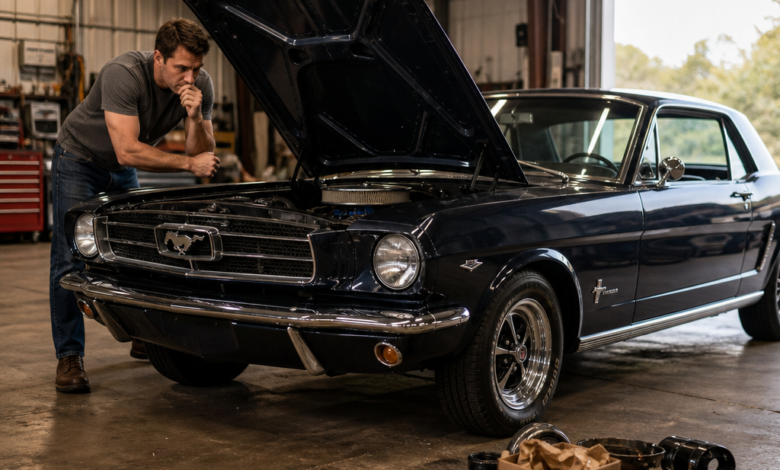
The photograph is usually what starts it. A fastback in Wimbledon White parked on wet asphalt, shot from a low angle so the front valance fills the frame. Somebody saves it, looks at it for three months, and then starts searching classifieds. That is how most first-generation Mustang purchases actually begin — not with a spreadsheet, but with an image that refuses to leave your head.
The trouble is that a photograph tells you nothing about torque boxes, nothing about floor pans, and nothing about whether the car will stop when a delivery van pulls out in front of you. This piece is about closing the gap between the picture and the driveway: what these cars genuinely demand, what the three main ownership routes cost you in money and patience, and where most buyers get it wrong.
Why the 1964½–1968 Mustang Still Dominates
Ford built the early Mustang in enormous numbers, and that single fact shapes everything about owning one. Parts availability is extraordinary — sheet metal, trim, wiring harnesses, interior kits and mechanical components are all in continuous production from multiple suppliers. You can buy a complete floor pan assembly for a ’66 coupe more easily than you can source a rear light lens for many European cars of the same era.
That abundance has two consequences. It keeps running costs sane, and it means the market is full of cars that have been assembled rather than restored. A Mustang can be built out of a catalogue, and plenty have been. Learning to tell a thoughtfully rebuilt car from a cosmetically dressed one is the single most valuable skill a buyer can develop.
The appeal beyond nostalgia
Drive a well-sorted small-block Mustang and the attraction becomes obvious fast. The car is light by modern standards, the sightlines are generous, the steering wheel sits close to your chest, and the exhaust note at 2,500 rpm does something no modern engine note does. It is also simple enough that an attentive owner can understand the entire car — ignition, fuel delivery, brakes, suspension — without specialist diagnostics.
The Three Ownership Routes
Broadly, there are three ways into a classic Mustang, and they suit very different temperaments.
- Buy a project. Cheapest entry, most expensive finish. A rough but solid shell plus a full rebuild typically costs more than buying a finished car outright, and it will occupy your weekends for two to four years. Choose this only if the process itself is the point.
- Buy a finished original. You pay for someone else’s labour, which is nearly always the better financial decision. The risk shifts from time to judgement: you must assess quality you cannot see.
- Buy a modernised reconstruction. Period bodywork and proportions, contemporary powertrain, brakes, cooling and safety systems. The highest cost, the lowest friction, and the route that gets used most often as an actual car.
Rust: The Only Inspection That Matters First
Everything else on a first-generation Mustang can be bought. Structural integrity cannot be bought cheaply. Before you look at paint, before you listen to the engine, get the car on a lift or at least on jack stands and check in this order:
- Torque boxes — the reinforcements where the floor meets the frame rails. Convertibles and fastbacks suffer most. Repair here is expensive and frequently done badly.
- Shock towers — cracks radiating from the upper control arm mounts are common and affect alignment permanently if ignored.
- Floor pans and footwells — pull the carpet. Fresh underseal sprayed over old metal is a warning, not a feature.
- Cowl area — blocked cowl drains soak the firewall and the passenger footwell. Water on the carpet after rain means a job that involves removing the windshield.
- Rear frame rails and trunk drop-offs — lift the spare tyre and look at the corners, not the middle.
Bring a magnet and a torch. Thick filler and a magnet that will not stick tell you more than any seller’s binder of receipts. And pay an independent inspector who knows these cars specifically — not a general pre-purchase service — because the failure points are so predictable that a specialist will find them in twenty minutes.
The Global Parts Picture Is Shifting
One quiet development worth watching is the industrialisation of reproduction body manufacturing. Supply chains now stretch far beyond the traditional American aftermarket, and reporting on the growth of overseas production of classic car bodies and panels shows just how globalised the restoration trade has become. For owners, that mostly means better availability and more competitive pricing on steel. It also means greater variation in fit and gauge, so asking a restorer which supplier they use — and why — is a fair and revealing question.
When You Want to Drive It, Not Fettle It
There is an honest conversation worth having with yourself: do you want a 1960s car, or do you want a car that looks like a 1960s car and behaves like something you can commute in? If it is the latter, the reconstruction route deserves serious attention. Specialists such as Revology build a new classic Mustang around the original silhouette while engineering in modern drivetrains, braking, cooling, climate control and electrical systems — which is why these cars tend to get used in traffic, in summer heat and on long drives rather than trailered to shows. The trade-off is clear and should be stated plainly: you give up originality and numbers-matching provenance, and you pay considerably more than for a restored period car. In exchange you get predictability, and for a lot of owners that is exactly the right bargain.
Living With One: Practical Budgeting
Beyond the purchase, plan for a first-year settling-in budget regardless of how good the car looked on collection day. Expect to replace rubber — tyres that look fine can be a decade old — flush the brake and cooling systems, re-tension and inspect the exhaust, and go through the fuel system if the car has sat. Budget for a proper alignment and a carburettor or fuel injection setup session, because almost every classic arrives slightly out of tune.
Storage matters more than most owners expect. A dry, ventilated space and a quality battery maintainer prevent the two most common causes of unplanned expense: moisture and electrical neglect. Insure on an agreed-value classic policy, not a standard one, and keep a photographic record of condition as you go.
Documentation as an asset
A car with a clear, visual record of what was done and when is worth measurably more at sale than an identical car with a verbal history. Photograph the bare shell, the welds, the suspension before it disappears under paint. The same principle that explains why better digital stories often begin with a single image applies to a restoration file: one honest photograph of clean metal does more for a buyer’s confidence than a page of claims.
Getting From Picture to Driveway
Decide your route before you start shopping, because each one attracts a different kind of seller and a different kind of disappointment. Set a budget that includes inspection, transport, registration and that first-year sorting work — not just the asking price. See three cars before you make an offer on any of them, even if the first one seems perfect; the comparison is what teaches you the market. And drive the car properly, at speed, with the windows up and then down, long enough for it to get hot.
Do that, and the Mustang you end up with will be the one you actually use. That is the only real measure of a good classic car purchase: not how it photographs, but how often you reach for the keys.