Cabinet Hinges Explained: Types, Overlays and What to Check Before Buying in Bulk

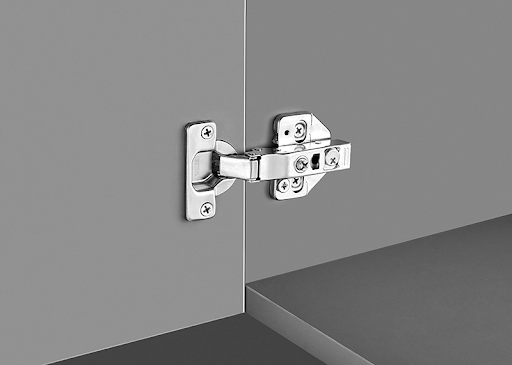
Short answer: most kitchen and wardrobe doors use a concealed cup hinge with a 35 mm cup. You choose it by overlay type (full, half or inset), opening angle (usually 105 to 110 degrees) and whether you want soft-close. After that, check the door’s weight and height to decide how many hinges each door needs.
The rest of this guide explains each of those choices in plain terms, so you can order with confidence and avoid the classic problem of doors that sag, rub or won’t stay aligned.
What is a cabinet hinge?
A cabinet hinge connects a door to the cabinet and lets it swing open and closed. On modern furniture the hinge is usually hidden when the door is shut. It has two parts: the cup, which sits in a round hole drilled in the back of the door, and the mounting plate, which screws to the cabinet side. An arm connects them, and small screws let you adjust the door up, down, left, right and in or out.
That adjustability is the whole point. No carcass is perfectly square, and no two doors hang identically. A good hinge lets you fix that in two minutes with a screwdriver.
What are the main types of cabinet hinges?
- Concealed (European) hinges. The standard for kitchens, wardrobes and bathroom units. Hidden, adjustable and available with soft-close.
- Butt hinges. Two flat leaves joined by a pin. Visible, simple and common on older or traditional furniture.
- Piano (continuous) hinges. One long hinge running the full height of a door or lid. Good for even support on fold-down desks and heavy lids.
- Pivot hinges. Fixed at the top and bottom edges of the door. Often used for tall doors or where a clean look matters.
- Glass door hinges. Clamp-style hinges made for glass panels, which can’t take a drilled cup.
- Clip-on hinges. A version of the concealed hinge where the door snaps on and off the plate without tools, handy for installation and cleaning.
If you’re buying for production furniture, you’ll almost always be ordering concealed hinges. They’re also where the quality gap between suppliers shows most clearly.
What does overlay mean on a hinge?
Overlay is how much the door covers the cabinet’s front edge. Getting this wrong is the most common ordering mistake, because the hinges look nearly identical.
- Full overlay: the door covers the whole side panel. Used when each door sits over its own carcass side.
- Half overlay: the door covers about half the panel, usually where two doors share one side panel.
- Inset: the door sits inside the opening, flush with the frame. It looks neat but needs very accurate cutting.
Measure the cabinet and decide the overlay first. Then pick the hinge arm shape that matches it. Full overlay arms are straight, half overlay arms are slightly bent, and inset arms are strongly bent.
What opening angle do you need?
Most hinges open to 105 or 110 degrees, which suits the majority of cabinets. Wide-angle hinges go to 155 or 165 degrees and are useful in corner units, where a door that only opens to 110 degrees can block access to drawers. Narrow-angle hinges, often 45 or 90 degrees, are made for situations where the door shouldn’t swing fully open, such as beside a wall.
Is soft-close worth it on a hinge?
In most cases, yes. A built-in damper slows the final few centimetres of the door’s travel so it closes quietly instead of banging. It protects the carcass and finish from repeated impact, and it’s one of the features buyers now expect in kitchens. Some hinges have the damper built in. Others use a separate clip-on damper, which gives you flexibility on older stock.
How many hinges does a door need?
There’s no single rule, but common guidance looks like this:
- Up to about 900 mm tall: two hinges
- Around 900 to 1500 mm: three hinges
- Above 1500 mm, or very heavy doors: four hinges
Heavier materials, such as solid wood or thick mirrored doors, call for more support than the height alone suggests. When in doubt, add one. A third hinge costs little and removes a lot of sagging problems.
What are hinges made of, and why does it matter?
Most concealed hinges are cold-rolled steel, nickel-plated for corrosion resistance. Stainless steel versions are used in bathrooms, outdoor cabinets and anywhere humidity is a problem. The finish matters as much as the base metal. Thin plating wears through, rust spots appear near the cup, and the hinge starts to bind.
Ask for salt spray test results, and check the cycle rating. Many quality hinges are tested for tens of thousands of open-and-close cycles. A kitchen door can easily open 20 to 30 times a day, so over ten years that adds up quickly.
What should you check before ordering hinges in bulk?
- Cup size and drilling pattern. The standard is a 35 mm cup, but confirm the boring distance and depth match your machines.
- Door thickness. Standard hinges suit doors of roughly 16 to 22 mm. Thicker doors need special hinges.
- Sample testing. Hang a few doors, load them and open them hundreds of times before the main order.
- Adjustment range. A hinge with a wider adjustment range saves installers time on site.
- Batch consistency. Make sure arm angles, spring tension and plating quality are the same on the thousandth piece as on the first.
- Packaging and labelling. Mixed-up overlays in one carton cause delays on the assembly line.
How do you choose a hinge supplier or manufacturer?
Start with what you actually need. A hinge supplier is often best for smaller mixed orders and fast delivery from stock. A door hinges manufacturer is better when you need volume, custom specifications or private labelling, because they control the tooling and the quality checks.
Good questions to ask any supplier: Can you share test data? Do you offer samples? What’s the minimum order quantity? How do you handle defects in a delivered batch? And can you supply matching drawer slides and other hardware, so the whole project comes from one source? Tallsen, for example, produces cabinet hinges alongside drawer systems and other furniture accessories, which makes ordering simpler for cabinet makers who need several products at once.
When you compare cabinet hinge manufacturers, look past the price list. Ask for the data sheet, read the cycle test numbers, and request a sample you can abuse. The ones confident in their quality will say yes.
Common hinge mistakes
- Ordering the wrong overlay because the hinges look the same.
- Using standard hinges on thick or heavy doors.
- Not allowing for clearance on corner units, which stops the door opening fully.
- Choosing the cheapest hinge and paying for it in site visits.
- Forgetting that wide mirrors and solid wood doors need extra hinges.
Final thoughts
Hinges are small, cheap and easy to ignore until they fail. Pick the right overlay, match the opening angle to the cabinet, use enough hinges per door, and test samples before you commit to a large order. Choose a supplier who can back up their claims with data, and your doors will keep closing properly long after the install.
Quick answers
What size is a standard cabinet hinge cup? 35 mm in most European-style hinges.
Can you adjust a concealed hinge after installation? Yes. Most have screws for height, side and depth adjustment.
Are clip-on hinges as strong as fixed ones? Good quality clip-on hinges are just as strong in normal use, and they’re quicker to fit and remove.
How long should a good cabinet hinge last? A well-made one should handle tens of thousands of cycles, which is many years of normal household use.