
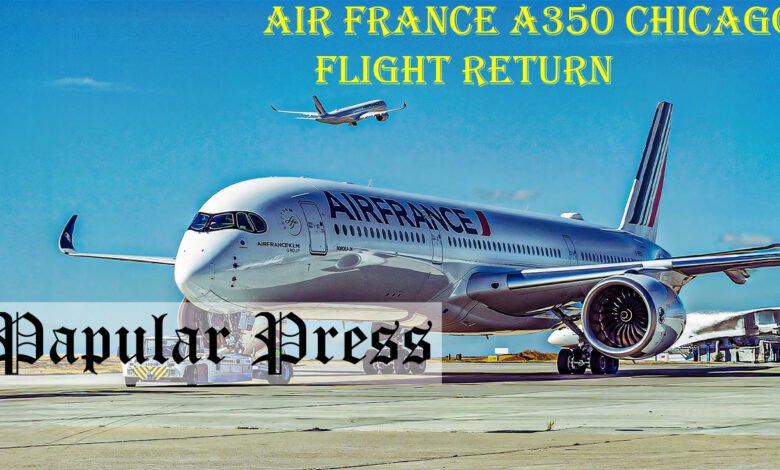
The Air France A350 Chicago flight return refers to a genuine, well documented aviation event in which flight AF136, operated by an Airbus A350-900, turned back mid-Atlantic after being denied landing clearance at Chicago O’Hare, ultimately returning to Paris after more than six hours in the air. This guide separates the verified facts of what actually happened from the inconsistent, speculative secondary content that has since surrounded the story.
What Actually Happened on Flight AF136
On June 28, 2025, Air France flight AF136, operated by an Airbus A350-900 aircraft registered F-HUVR, departed Paris Charles de Gaulle Airport at 12:49 local time bound for Chicago O’Hare. The crew made the decision to return to France after being denied landing clearance at Chicago O’Hare, turning the aircraft around at approximately 16:30 Central European Summer Time while flying over the mid-Atlantic between Iceland and Greenland, having already completed nearly half of the transatlantic journey before reversing course.
Why the Flight Was Denied Clearance
Air France cited operational reasons for the denied landing clearance without providing further specific public detail, a level of disclosure that, while frustrating for passengers seeking a fuller explanation, is not unusual for airlines responding to operational disruptions of this kind, where the precise underlying cause, whether related to air traffic control capacity, weather, or another operational factor, is not always disclosed publicly in detail.
How Long the Flight Actually Lasted
The aircraft ultimately landed safely back in Paris after a total flight time of six hours and thirty seven minutes, reflecting the genuinely unusual nature of this event, a flight that flew most of the way across the Atlantic before needing to reverse course entirely and fly the same distance back, rather than diverting to a closer alternate airport.
How Air France Handled Affected Passengers
Following the aircraft’s return to Paris, Air France provided overnight accommodations for the affected passengers and rebooked them onto a replacement flight, AF4080, which departed the following day. documented this passenger handling process as part of its broader reporting on the event, providing a genuinely reliable primary account of how the disruption unfolded.
Why This Was Not an Isolated Incident for This Specific Route
Independent aviation tracking coverage has also documented a separate, related incident in which an Air France flight bound for Chicago, also identified as AF136, made a U-turn over the Atlantic due to clearance issues around the same general period, suggesting this Paris to Chicago route experienced more than one disruption of this general kind within a relatively short span of time, a detail worth noting when trying to understand the full picture.
Why Genuine Aviation Incidents Attract Secondary Content
Once a specific aviation event like this receives credible coverage from established aviation industry and news outlets, it frequently attracts a secondary wave of generic content sites publishing their own articles about the same event, often published well after the actual incident and sometimes carrying publication dates that extend surprisingly far into the future relative to when the event actually occurred, a pattern that does not necessarily mean the underlying event itself is fake, but does mean these secondary articles should not be treated as reliable additional sources beyond what the original credible coverage already established.
How to Tell Genuine Coverage Apart From the Surrounding Noise
The clearest way to separate reliable information about this event from surrounding noise is to look specifically for aviation industry publications and established news outlets that reported on the event close to when it actually happened, rather than generic lifestyle or general interest sites publishing significantly later, often with vague or recycled descriptions that add no new verified detail beyond what the original credible sources already reported.
Why Passengers Experiencing a Similar Disruption Should Know Their Rights
Passengers affected by a significant flight disruption of this kind, including a flight that turns back mid-journey, are generally entitled to certain protections depending on the specific circumstances and the applicable regulatory framework for the route involved. outlines the kinds of accommodations, rebooking, and potential compensation passengers may be entitled to, though the specific entitlement depends heavily on the exact cause of the disruption and the jurisdiction governing the flight.
What This Case Illustrates About Verifying Aviation News Generally
This specific case offers a useful, concrete illustration of how to approach aviation incident claims generally, a genuine, well documented event can still end up surrounded by a cluster of lower quality secondary content, making it worth tracing any specific claim back to its original, credible source rather than relying on whichever article happens to appear first in a general search result.
Why Transatlantic Clearance Issues Are a Recognized, if Uncommon, Occurrence
While a flight turning back mid-ocean after being denied landing clearance is genuinely uncommon, it is not without precedent within commercial aviation, since air traffic control capacity constraints, severe weather at the destination, or other operational factors can occasionally force a crew to make exactly this kind of difficult decision partway through a long transatlantic crossing rather than risk arriving at a destination unable to accept the aircraft. has noted that these situations, while rare, are a recognized operational contingency airlines train and plan for precisely because long haul routes occasionally encounter unexpected destination constraints mid-flight.
Why Checking the Specific Aircraft Registration Can Help Confirm a Claim
One particularly useful verification detail in a case like this is the aircraft’s specific registration number, since this allows independent confirmation through aircraft tracking databases that a specific physical aircraft genuinely operated the described route on the specified date, offering a more concrete, independently checkable detail than a flight number alone, which as with other cases discussed in aviation reporting can be reused across different dates and routes.
Why This Guide Separates Verified Facts From Surrounding Speculation
Throughout this guide, each specific fact presented, the flight number, the aircraft registration, the exact date and timing, and the passenger rebooking details, traces back to established aviation industry coverage published close to when the event actually occurred. recommends this same approach for any aviation or news event that has since accumulated a secondary layer of less reliable commentary, since tracing claims back to their original source remains the most reliable way to confirm what is actually known.
Why This Specific Route Carries Particular Operational Complexity
The Paris to Chicago route specifically involves a considerable distance and a correspondingly long flight time, meaning any mid-journey decision to reverse course carries significant operational and logistical weight for the airline, from fuel planning considerations to the eventual need to accommodate and rebook a full planeload of disrupted passengers once the aircraft lands back where it started.
Why This Event Still Attracted Public Interest Despite Its Rarity
Even though mid-ocean diversions of this kind are genuinely uncommon, this particular event attracted considerable public attention precisely because of how unusual and visually striking it was, a wide body aircraft flying nearly to the midpoint of a transatlantic crossing before reversing course entirely, a scenario vivid enough to generate sustained interest well beyond the initial aviation industry reporting that first documented it.
What Travelers Booking This Route Can Learn From This Case
Travelers regularly booking long haul transatlantic routes can take a useful lesson from this specific case, understanding that while this kind of mid-flight reversal is rare, travel insurance and flexible booking options remain worth considering for any long haul journey, since even a well run airline can occasionally encounter an operational situation entirely outside its passengers’ control, and having some flexibility built into a travel plan can meaningfully ease the disruption if something similar were ever to happen again on a future trip.
Why Clear, Well Sourced Reporting on Events Like This Matters
Clear, well sourced reporting on genuinely unusual aviation events like this one serves a real public interest, helping travelers and aviation enthusiasts alike understand what actually happened without needing to wade through layers of lower quality secondary content that add confusion rather than clarity, which is precisely the goal this guide has aimed for throughout, and the same careful approach applies equally well to any other unusual aviation story a reader might come across in the future.
A Quick Recap of the Key Facts
To summarize, Air France flight AF136, an Airbus A350-900, turned back mid-Atlantic on June 28, 2025, after being denied landing clearance at Chicago O’Hare, ultimately returning to Paris after six hours and thirty seven minutes in the air, with affected passengers provided overnight accommodation and rebooked onto a replacement flight the following day, a genuine, well documented event now surrounded by a significant amount of lower quality secondary content worth approaching with caution.
Why This Event Remains a Genuinely Interesting Case Study
Beyond its practical lessons about verification, this event remains a genuinely interesting case study in its own right, illustrating just how far into a long haul crossing a flight crew might need to travel before a destination side operational issue becomes fully apparent, a detail that offers real insight into the kind of split second, high stakes decisions flight crews are trained to handle.
How This Event Compares to Other Notable Transatlantic Diversions
Aviation history includes a number of other notable cases where a long haul flight needed to reverse course or divert partway through a transatlantic crossing for reasons ranging from medical emergencies to mechanical issues to destination side constraints like the one documented here, and comparing this specific event against that broader pattern helps situate it as a genuinely rare but not entirely unprecedented occurrence within commercial aviation.
Why the Specific Aircraft Type Is Also Worth Noting
The involvement of an Airbus A350, one of the newest and most advanced wide body aircraft types in widespread commercial service, is also a detail worth noting, since it confirms this was a long haul, purpose built transatlantic aircraft rather than a smaller, shorter range plane, consistent with the aircraft type Air France genuinely operates on this specific Paris to Chicago route, and further reinforcing that this was a real, substantial long haul operation rather than a minor regional flight.
A Final Practical Reminder
Whenever you come across a dramatic aviation story that has clearly attracted a wave of secondary coverage, tracing the specific details back to the earliest, most credible reporting available remains the single most reliable way to separate what genuinely happened from whatever has since been added, embellished, or recycled around it.
Conclusion
The Air France A350 Chicago flight return refers to a real, well documented event in which flight AF136 turned back mid-Atlantic after being denied landing clearance at Chicago O’Hare on June 28, 2025, ultimately returning to Paris after more than six hours in the air before passengers were rebooked onto a replacement flight. While the underlying event is genuine and well sourced through established aviation industry coverage, readers should be cautious of the secondary, lower quality content that has since accumulated around the story.
Frequently Asked Questions
Did the Air France A350 Chicago flight return actually happen?
Yes, this is a genuine, well documented event. Flight AF136 turned back mid-Atlantic on June 28, 2025, after being denied landing clearance at Chicago O’Hare.
Why was the flight denied landing clearance?
Air France cited operational reasons without providing further specific public detail, a level of disclosure not unusual for airlines responding to this kind of disruption.
How long was the flight in the air before returning to Paris?
The flight lasted six hours and thirty seven minutes in total, having flown nearly to the midpoint of the Atlantic crossing before reversing course back to Paris.
What happened to passengers after the flight returned to Paris?
Air France provided overnight accommodations and rebooked affected passengers onto a replacement flight, AF4080, which departed the following day.
Why are there so many different articles about this event online?
Once an event like this receives credible initial coverage, it often attracts a wave of generic secondary content published later, which should be approached with more caution than the original established aviation industry reporting.