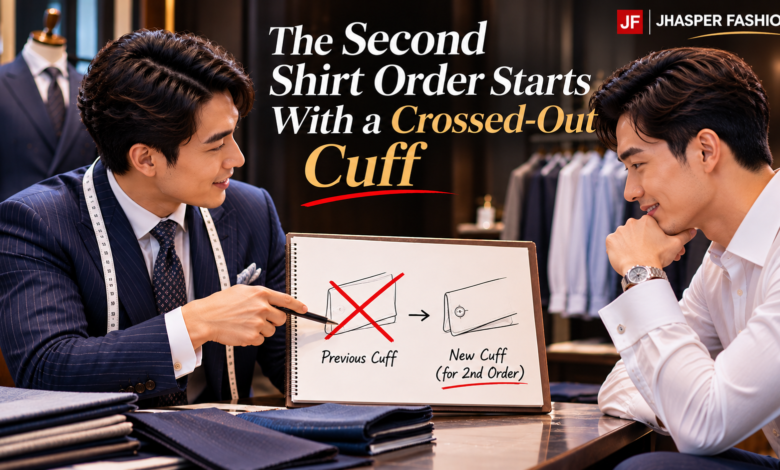
Take a pen to a shirt order and cross out “French cuff.” Write “button cuff” in the margin. It looks like a tiny amendment until a second shirt is being cut and three people have three perfectly reasonable accounts of what the customer meant. Was the change for this shirt, for travel shirts, or for every shirt from now on?
Repeat business is often described as a sale that gets easier the second time. For a small service business, it can also be the first time an old decision comes back without the conversation that explained it. A shirt makes a good case study because a person can keep the same wrist measurement and acquire a perfectly good reason to change the cuff.
Give the exception an expiration date
Imagine an attorney who wears cuff links in court and leaves them at home on overnight trips. When he orders a blue travel shirt, “button cuff on blue” is enough to make today’s garment. Six months later he asks for his usual white shirt. If the blue order has silently become his profile, the most recent information in the file is also the least relevant.
A small shop can keep the distinction on paper. On one line, record the standing preference. On another, record what applies to this garment and why. Date both. A short reason such as “packs without cuff links” will do more work than a page of polite correspondence. It gives the next person taking an order a concrete question to ask.
Give the garments names the customer will recognize. A fabric code might identify a bolt of white cotton down to the last digit, but both the wedding shirt and the courtroom shirt could have come from that bolt. Add the occasion beside the code. Months later, a customer calling from an airport can say “the one I wore to my sister’s wedding” and give the person answering the phone something useful to find.
Read back what survived
Bangkok tailor Jhasper Fashion says it keeps measurements on file for returning clients. The interesting business question begins where measurements end. A number can spare a customer the trouble of starting over. It cannot say whether the customer still takes overnight trips or has switched to a watch with a thicker case.
A useful read-back takes one sentence. “We have the collar from your white shirt and the button cuff from your blue travel shirt. Which cuff would you like on this one?” The buyer can answer without knowing a style number, and the maker can enter a choice that belongs to this particular order. The extra minute buys clarity on both sides of the counter.
Send that sentence with the order confirmation, where the customer can correct it before anyone cuts cloth. If the answer arrives by phone, put the date and the cuff the customer chose on the same record. Otherwise the most accurate version of the order lives in the memory of whoever happened to pick up.
When the next reorder comes in, the crossed-out cuff should still be legible. So should the date, the garment it belonged to, and the decision that replaced it. There is value in remembering a customer. There is more value in remembering exactly what the customer asked you to remember.