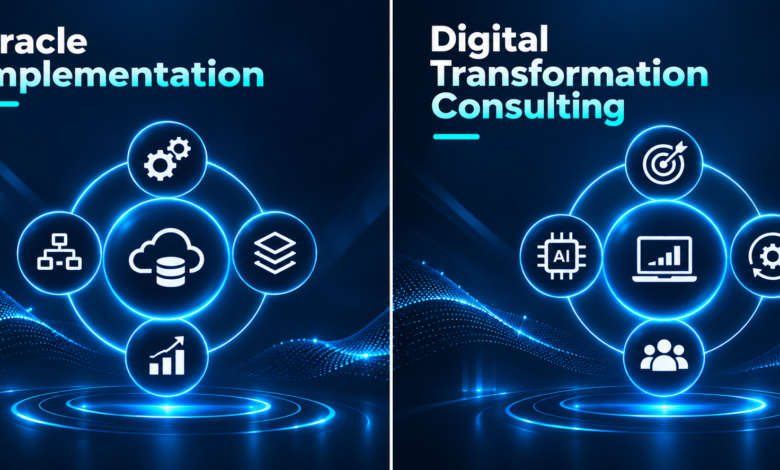
Oracle Implementation and Digital Transformation Consulting: Modernizing the Enterprise Without Carrying Forward Legacy Complexity

Replacing legacy enterprise applications with modern cloud platforms presents an opportunity to improve how an organization operates. However, businesses that reproduce outdated workflows, fragmented data structures and inefficient approval procedures within new applications may achieve limited performance improvements.
An Oracle implementation provides the technology foundation for connecting enterprise processes, improving information visibility and standardizing operations. Digital transformation consulting helps organizations determine which business capabilities should change and how modernization can support strategic objectives.
Their combined value lies in creating an enterprise environment that is simpler to manage, more responsive to business requirements and better positioned to accommodate future growth.
Why legacy complexity should not migrate to the cloud
Over time, enterprise applications accumulate customizations, manual workarounds and integrations designed to address specific operational requirements. Some remain necessary, while others reflect outdated business practices.
Transferring these arrangements into a modern cloud environment can increase implementation costs and restrict future flexibility.
An Oracle implementation creates an opportunity to evaluate whether existing processes, configurations and technical dependencies remain relevant.
Digital transformation consulting provides an independent perspective on these requirements, helping organizations distinguish essential business capabilities from unnecessary complexity.
This assessment can prevent modernization programs from becoming expensive exercises in reproducing legacy operations.
What is Oracle implementation?
Oracle implementation is the process of configuring, integrating and deploying Oracle enterprise applications to support organizational processes and business requirements.
Depending on the scope, implementation may involve Oracle Fusion Cloud Enterprise Resource Planning (ERP), Human Capital Management (HCM), Supply Chain Management (SCM) or Enterprise Performance Management (EPM).
Typical activities include business process design, application configuration, data migration, system integration, testing and workforce preparation.
The objective is to establish an integrated application environment that supports reliable operations and provides flexibility as organizational requirements evolve.
How does digital transformation consulting support enterprise modernization?
Digital transformation consulting helps organizations align technology modernization with business strategy, operational performance and organizational capabilities.
Consultants evaluate existing processes, identify performance gaps and establish investment priorities. They also assess technology requirements, organizational readiness and implementation dependencies.
During an Oracle implementation, this expertise can help leadership teams determine which processes should be standardized, where specialized capabilities are necessary and how the future application environment should support enterprise objectives.
The emphasis is on improving business performance rather than completing a technology deployment alone.
Four critical decisions that influence implementation outcomes
Standard functionality versus customization
Modern enterprise applications provide configurable capabilities for common business processes. Organizations should evaluate whether these capabilities satisfy their requirements before introducing custom developments.
Excessive customization can increase maintenance expenditure and complicate future application updates.
Centralized versus decentralized operations
An Oracle implementation may create opportunities to consolidate transaction processing, reporting and administrative activities.
However, service delivery decisions should reflect operational requirements, regulatory differences and the need for local expertise.
Historical data versus relevant information
Migrating every historical record may introduce unnecessary complexity. Organizations should determine which information is required for operational continuity, reporting, regulatory compliance and future analysis.
Technology ownership versus business ownership
Application management and process performance require different responsibilities. Digital transformation consulting can help establish accountability across business process owners, technology teams and service delivery organizations.
Connecting Oracle applications with enterprise-wide improvements
The value of integrated enterprise applications becomes clearer when examined across interconnected business functions.
A coordinated Oracle implementation can establish common information flows across these functions. Digital transformation consulting helps ensure that these capabilities support broader enterprise performance rather than isolated departmental improvements.
A practical example: Transforming a multinational finance organization
Consider a multinational business operating multiple accounting applications across regional subsidiaries. Finance teams follow different reporting procedures, maintain separate account structures and manually consolidate financial information.
Leadership wants to accelerate financial reporting and reduce administrative costs.
Through digital transformation consulting, the organization could identify inconsistent accounting processes, fragmented data and duplicated activities as major performance constraints.
An Oracle implementation could subsequently establish standardized accounting structures, integrated financial reporting and common transaction processing capabilities.
However, realizing the expected benefits would also require redesigned responsibilities, consistent financial policies and appropriate workforce preparation.
The transformation could improve reporting efficiency and financial visibility while reducing the complexity associated with maintaining multiple applications.
Preparing enterprise applications for artificial intelligence
Modern enterprise platforms can provide a foundation for introducing artificial intelligence into business operations.
Predictive analytics can support financial forecasting and demand planning. Generative AI can help employees interpret reports, retrieve organizational knowledge and investigate operational exceptions. AI agents can coordinate approved activities across enterprise workflows.
An Oracle implementation should consider how application architecture, data structures and integrations can accommodate relevant intelligent capabilities.
Digital transformation consulting can help organizations evaluate AI opportunities according to business value, implementation feasibility and operational risk.
Introducing intelligence should remain a performance-led decision rather than an automatic component of every modernization initiative.
Managing the transition without disrupting business operations
Enterprise application deployment can affect critical activities such as financial reporting, purchasing, payroll and customer order fulfillment.
Organizations must therefore balance implementation speed with operational continuity.
Important considerations include:
Validating migrated information against established business requirements.
Testing end-to-end processes across interconnected applications.
Maintaining appropriate financial, operational and security controls.
Preparing employees for redesigned workflows and responsibilities.
Establishing contingency arrangements for critical business activities.
Providing structured postimplementation support.
Digital transformation consulting can help coordinate these organizational requirements with technical implementation activities, reducing the risk of operational disruption.
Evaluating the total cost of enterprise modernization
The financial case for an Oracle implementation should extend beyond software licensing and initial deployment costs.
Organizations must consider integration expenditure, data migration, application maintenance, workforce development and ongoing technology management.
Expected benefits should include potential improvements in process costs, workforce productivity, reporting efficiency, working capital and technology reliability.
Digital transformation consulting can support this assessment by connecting expected operational improvements with investment requirements and implementation dependencies.
A defensible business case should distinguish between projected benefits and realized financial returns.
Why transformation continues after the system goes live
Cloud enterprise applications evolve through regular updates, new functionality and changing integration requirements.
Organizations need ongoing capabilities for evaluating application changes, monitoring process performance and identifying additional improvement opportunities.
Business process owners should assess whether implemented workflows remain effective, while technology teams maintain application reliability and security.
Continuous improvement helps ensure that enterprise applications remain aligned with changing business priorities rather than becoming another source of legacy complexity.
Conclusion
An Oracle implementation provides a foundation for integrated enterprise applications, standardized processes and improved information accessibility. Digital transformation consulting connects these capabilities with strategic priorities, organizational requirements and expected business outcomes.
The greatest value emerges when businesses use modernization as an opportunity to challenge outdated practices rather than reproduce them within new technology.
By combining disciplined implementation, process redesign, workforce readiness and continuous performance management, organizations can reduce operational complexity and achieve sustainable returns on enterprise technology investments.