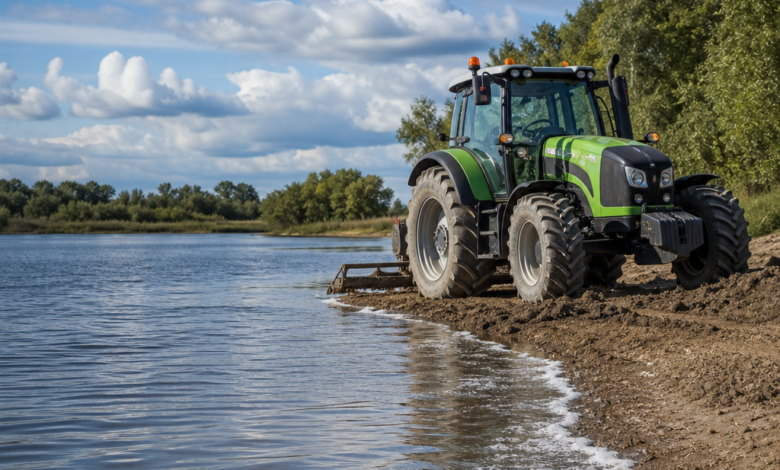
Most conversations about water quality start in the water. But if you have ever surfaced from a shallow reef after a week of rain and found the visibility knocked down to arm’s length, you already know how much of what happens underwater is decided uphill. Sediment, nutrients and the occasional sheen of diesel arrive from the land, and a surprising amount of that land is worked by tractors — hobby farms on an estuary, oyster and pearl leases with a shore base, coastal pasture, levee banks and the gravel tracks that lead down to every boat ramp in the country.
That connection becomes obvious when you look at aquaculture that depends on clean water to survive commercially. Low-impact pearl farming is a useful reminder that the farm and the lagoon are one system: the shore-side yard, the access road, the fuel drum and the tractor that moves cages, feed and gear are all part of the operation’s environmental footprint. If you own waterfront acreage, manage a research station, or simply maintain a rural property with a creek running through it, the machine parked in your shed matters more than you might think.
Right-sizing the machine beats buying big
The most common and most expensive mistake on small coastal properties is buying too much tractor. Oversized machines burn more fuel at part load, compact wet soils faster, chew up soft tracks and are awkward in the tight spaces where shore work actually happens — between racks, along a jetty approach, inside a shed.
A rough framework helps. Sub-compacts and compacts, broadly in the 20–45 horsepower band, suit mowing, light loader work, moving bins and gear, post-hole digging and grading a driveway. Utility tractors, broadly 45–80 horsepower, start to make sense when you are running a round baler, a heavier mixer, a three-point implement with real width, or when you need a loader that lifts a full pallet of feed without the front end getting light. Above that, you are buying for row-crop or contracting work, not shore maintenance.
Specs worth arguing about
- PTO horsepower, not engine horsepower. Implements are rated against what reaches the shaft, and the gap between the two numbers is real.
- Hydraulic flow and remote valves. If you plan to run a grapple, a trailer tipper or any hydraulic attachment, specify the remotes at purchase. Retrofitting is always dearer.
- Transmission type. Hydrostatic is forgiving for loader cycles and stop-start yard work; a geared or shuttle transmission is more efficient for sustained draft work and generally costs less to maintain.
- Tyres. Turf tyres protect grass and soft shoreline soil, industrial tyres take gravel and abrasion, agricultural tread gives traction in mud. On wet ground, wider tyres at lower pressure spread the load and reduce rutting.
- Four-wheel drive and ballast. On sand, boat ramps and saturated clay, 4WD is not a luxury, and correct rear ballast keeps the rear wheels doing the work rather than spinning.
If you are starting from zero, it pays to read a structured buyer’s walkthrough before you shop. This ultimate guide to buying a tractor from Farmers Weekly covers the questions dealers wish buyers would ask — hour meters, service history, emissions systems, cab versus ROPS — and it will keep you from being talked into either too much machine or too little.
Fuel burn is an environmental spec
Every litre of diesel you do not burn is emissions you do not produce, and it is also one less litre to store, decant and potentially spill near a waterway. Operators who track fuel carefully tend to find the savings in habits rather than hardware: matching engine speed to the job instead of running flat out, using the correct gear so the engine is not labouring, keeping air filters clean, checking tyre pressures weekly, switching off instead of idling through a long loading break, and ballasting properly so the tractor pulls rather than slips.
Maintenance discipline is what makes those habits stick, and that is where a dealership relationship earns its keep. H&R Agri-Power, a farm and outdoor power equipment dealership with locations across Kentucky, Tennessee, Indiana and surrounding states, sells new and used equipment including Kubota tractors and backs it with genuine parts and repair service — which is the practical combination you want when a filter change or an injector issue is the difference between a machine that sips fuel and one that wastes it. Their guidance on Kubota tractor fuel efficiency is worth reading alongside your operator’s manual, because most of what it describes — service intervals, load matching, tyre and ballast setup — applies to any make you happen to own.
A seasonal checklist for waterfront properties
Salt air, humidity and sand accelerate wear in ways an inland farm never sees. Build the service year around that.
- Before the wet season: change engine oil and filter, inspect hydraulic hoses for cracking and weeping, grease every pin and bush on the loader, check the condition of the radiator and oil cooler fins, and confirm the battery terminals are clean and protected.
- Monthly in heavy use: wash salt and sand off the underside and loader arms, blow out the air pre-cleaner, check coolant and hydraulic levels, inspect tyres for sidewall cuts from shell and rock.
- Before storage: fill the fuel tank to limit condensation, treat fuel if the machine will sit, grease exposed cylinder rods, and park under cover on a hard surface rather than on wet grass.
- Always: keep an absorbent spill kit with the machine and refuel away from drains, banks and the tide line. A funnel and a drip tray cost almost nothing and prevent the one mistake that ends up in the water.
Parts, repairs and the case for a local relationship
Genuine filters and seals matter more than they sound. Modern diesel engines run tight tolerances and high injection pressures; a cheap fuel filter that lets fine particles through is a false economy that can cost you an injection pump. The same goes for mower blades, baler teeth and hydraulic fittings, where a poor match causes vibration, leaks or premature failure.
Build the relationship before you need it. Give your dealer the model and serial number, keep your own service log with hours and dates, and ask the parts counter to note your machine on file so reordering is quick. Ask what the service department can do on site versus what has to come in. If you run more than one machine, stagger the services so you are never without something that can tow a trailer or lift a pallet during a storm. And when you sell, that log is the single thing that most reliably protects resale value.
The dive connection, stated plainly
Divers and underwater photographers spend a lot of energy documenting damage after it reaches the water. The less glamorous work happens on land: a tractor sized to the job, running clean, serviced on schedule, refuelled carefully and kept off saturated ground when it should be parked. That is not a conservation campaign. It is just competent equipment management — and on a shoreline property, competent equipment management and clean water are the same project.